Having survived valve repair surgery and an experimental cardiac bypass at age 5, three years before it was an accepted medical procedure, Susan grew into the size of her overworked and enlarged heart. Maybe she thought she had enough to give it away -- twice. Both times, she had to retrieve the shattered pieces and puzzle them back together. She thanks her Dad for the only advice of his she ever followed to the letter: "Never get married. Learn to take care of yourself." So of course she is a writer. Susan has co-written a YA SciFi novel, and has three more novels in various stages of evolution. She's had several short stories published in other people's anthologies, some of which were contest-related.
Let her tell you a story...
Benjamin Gorman, Co-Publisher of Not a Pipe Publishing, high school teacher, and best selling Amazon author invited me to share some advice. It’s the most convincing explanation I’ve ever read about why and how writers should use social media.
This is the first of his eight insightful points. I hope you’ll read the rest here.
“1. Your website is passive.
Back when I was making the switch from a guy with one book and a logo to co-publisher, I knew I needed a slick website, so I went to a friend who was a pro to get his help. He taught me one of the most important distinctions that’s served me well in all my investments of time online. “Your website is passive,” he told me. “No one will know what’s there until you direct them to it.” Before I understood this, I’d visited the websites of some of my favorite authors, people who are pulling in significant annual incomes from their writing, people who could afford to have really fancy, expensive-looking sites, and, with a few exceptions, I found that their sites were pretty blah, and some were downright cheap looking. Foolish me, I thought, “Ha! I will have this competitive advantage by having a fancy, expensive site! I’m so much smarter than these incredibly successful authors!” Nope. Turns out they’re successful because they’re a lot smarter. They knew (or hired smart people who knew) that the website doesn’t make much of a difference. You should have one. It can be a free one. It’s basically a business card with links to your books, your bio, and a place to announce events. And even then, no one will know about the events you identify there unless you tell them elsewhere, because your website is passive. There are authors who develop a following with blogs, but the website is just a repository for that content. The audience is drawn to it because those authors go to social media to let folx know when they’ve added a post. Unless you are so successful people will search for your name, don’t sweat the website. And if you are so successful people are searching for your name, don’t sweat the website.”
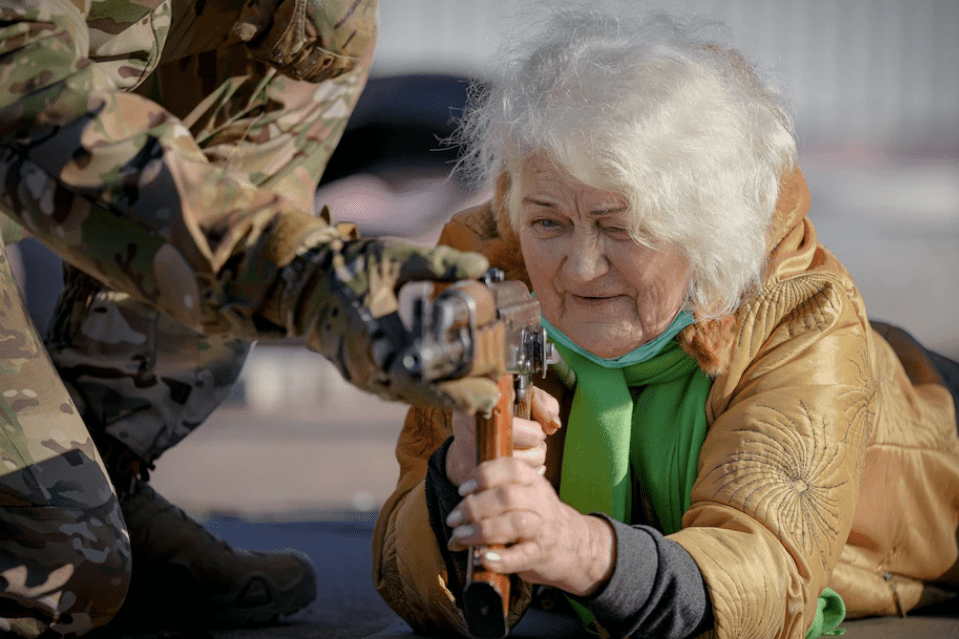
Valentyna Konstantynovska, 79, holds a weapon during basic combat training for civilians. (Vadim Ghirda/AP)
Monica Hesse, a columnist for The Washington Post, has written a thoughtful and moving piece that WaPo is letting subscribers gift to non-subscribers. I want to gift it to you.
The current writing prompt is Kicking off. My response is below. I hope you’ll take a look at the others over at Writers Co-op. They range from thoughtfully instructive to historically fictional to tragically comical and just plain fanciful. What would you have written? The next prompt is:
License
What would you do with that? I hope you’ll give it a try. Your entry is due by Monday, March 7, 2022. Submission guidelines are easy: any genre, approximately 6-1,000 words. Send as a .doc, .docx, or .pdf attached to an email addressed to me at stranscht@sbcglobal.net. Please do join us. We are planning on publishing an anthology for which each author chooses two or three of their own favorite submissions.
And please share our posts with your family and friends.
All You Have to Do
by S.T. Ranscht
It began as a joke, a harmless prank. Isn’t that what big brothers are for?
“It’s true, I promise you,” I told her, “but only special people can do it.” She was six and I was eleven — she had to believe me.
She took one of the rocks from her left hand and threw it at a sapling ten feet away. It bounced off the center of the skinny trunk.
I didn’t let on I was impressed. “Honest,” I said. “Do you want to learn how?”
She pulled back one corner of her mouth and looked at me sideways. “I asked Mommy, and she said no one can fly except in an airplane or a rocket.”
“She said that because she never even flew in her dreams. Sorry, kid, but our mom just isn’t quite special enough to soar like a Condor. Of course, you can spend your life on the ground if you want, and never even try, but then you won’t be any more special than Mom.”
As soon as I said it, I knew it was the wrong thing to say. She launched another rock and it hit exactly where the first one did. Then she turned on me.
“Mommy is too special. She’s the most special mommy in the whole world.”
I knelt in front of her. “You’re right, Sadie. She is. She probably just wants to keep you safe. Flying can be dangerous. It’s tricky to master and easy to get hurt doing it.”
“How? How can you get hurt?”
“You might get caught in an updraft and not be able to escape until it drops you someplace like the North Pole. Or China.”
She looked at me from beneath her scrunched eyebrows. “What’s an updraft?”
“It’s like riptide at the beach,” I said, knowing how much Dad’s warnings about that had scared her, “but it’s in the air and it sucks you up instead of down.”
Shrugging, she threw her last rock at the same spot. Bullseye. “And besides, if I went to China, I could call Mommy and Daddy and they would come and get me. I know their phone numbers, dummy.”
“Well, peabrain, you wouldn’t be able to call if you got caught in the top of a Giant Sequoia or sucked into a jet engine, would you?”
Her shoulders slumped. “No.”
“Okay.” I held her shoulders so we were face to face. “If you want to learn how to fly, I can teach you.”
“How?”
“There’s lots of ways,” I said, ticking them off on my fingers. “Some people just wiggle their toes and they rise up off the ground,” I could see her toes wiggling inside her sneakers. “Or maybe you’ll need to run downhill, spread your arms, and catch the wind.”
Sadie looked around. “We don’t have many hills around here.”
“My friend Doug says if you stand at the edge of something tall like a cliff or a skyscraper and throw yourself at the ground, all you have to do is miss.” I figured what was the harm? Sadie wouldn’t read Hitchhiker’s Guide for at least five more years.
Wrinkling her nose and shaking her head, Sadie said, “I don’t think that would work for me. I’m really good at throwing. I never miss.”
She got quiet. I could tell she was thinking. I stood up.
She looked up at me and narrowed her eyes. “Show me how you fly.”
I was ready for this. “I can’t show you yet because only flyers are allowed to see other people fly. If they let non-flyers see them, they can never fly again.”
“Then how am I s’posta—“
I held up one finger. “I can tell you, and once you learn how, we can fly anywhere, anytime you want.”
She made an exasperated little noise and said, “Okay. Tell me how you fly.”
“It’s easy. I stand with my knees bent just a little, and my arms ready to reach for the sky. Like this.” I posed like I was gonna take a free throw in basketball. “Then I pick up one foot — not too high — and KICK it down, hard, to the ground. Then I take off.”
Sadie stood like I was standing, except her little butt was sticking out. I had to work really hard not to laugh. “Okay, lift one foot…”
“Which one?” she asked.
“It doesn’t matter. Whichever one you want.”
She did.
“Now, KICK it down. Hard!”
She did.
She looked at me. “It didn’t work.”
“It’s okay. Nobody gets it the first time. Show me how you stand again.” Real serious like, I walked around her, looking her up and down. “I think I see your problem. Straighten you back a little, your butt is sticking out too far.”
She did just what I told her to do.
“Now lift your foot…”
She used the same foot as before.
“Now KICK down!”
She did, and of course, she was still standing on the ground. She immediately went into her pose again. Gotta give the kid points for determination.
“I’m gonna try the other foot this time.” She picked it up before I could say to.
“Good idea. Now KICK!”
She closed her eyes and KICKED.
“Gosh, Sadie, I’m really sorry. I thought this would work. I thought you were ready. Tough luck, kid.” I started back for the house.
“Wait! I almost had it, I know I did, but I think I wasn’t standing straight enough. Watch me, okay? One more time. Just one more. Pleeeease?”
How could I say no?
She took her stance. “How do I look? Is my butt sticking out?”
“No,” I said, “you look good. Go ahead, lift a foot.” She chose her second choice again. “Now…”
She kicked down. Hard.
And she shot into the air like she had springs on her feet and wings on her arms!
“Sadie!” I shrieked, “You’re flying!” This was impossible, but there she was, wheeling and tumbling like one of those crazy pigeons.
She bounced a little when she came down way over by a bunch of oak trees, but she landed on her feet. Then it looked like she was picking something up.
When she kicked off again, she rose as high as the tops of the trees before she turned and flew straight toward me.
Flying in a circle above me she yelled, “Now show me how you take off.”
I took my stance, lifted a foot, kicked down hard, and took off — running!
Sadie was right behind me, pelting me with acorns, and calling, “You liar. You can’t fly!”
I shouted back over my shoulder, “Nobody can fly, Sadie. Not even you.”
What can I say? I was eleven, she was six. She had to believe me.
She dropped out of the air, right on top of me. Lying on the ground, we were both all right, but she jumped up, angry.
“You tricked me,” she said. “You’re a non-flyer and you made me fly in front of you and now I’ll never be able to fly again.” And she ran off to the house, crying, “Mommyyyyy!”
It began as a joke. A harmless prank. But as far as I know, Sadie never flew again.
(This title refers to a previous post. Two previous posts, to be honest — my very first 7 years ago, and as a bonus to my first anniversary post. You are welcome to take a look. In fact, please do.)
Anticipation
by S.T. Ranscht
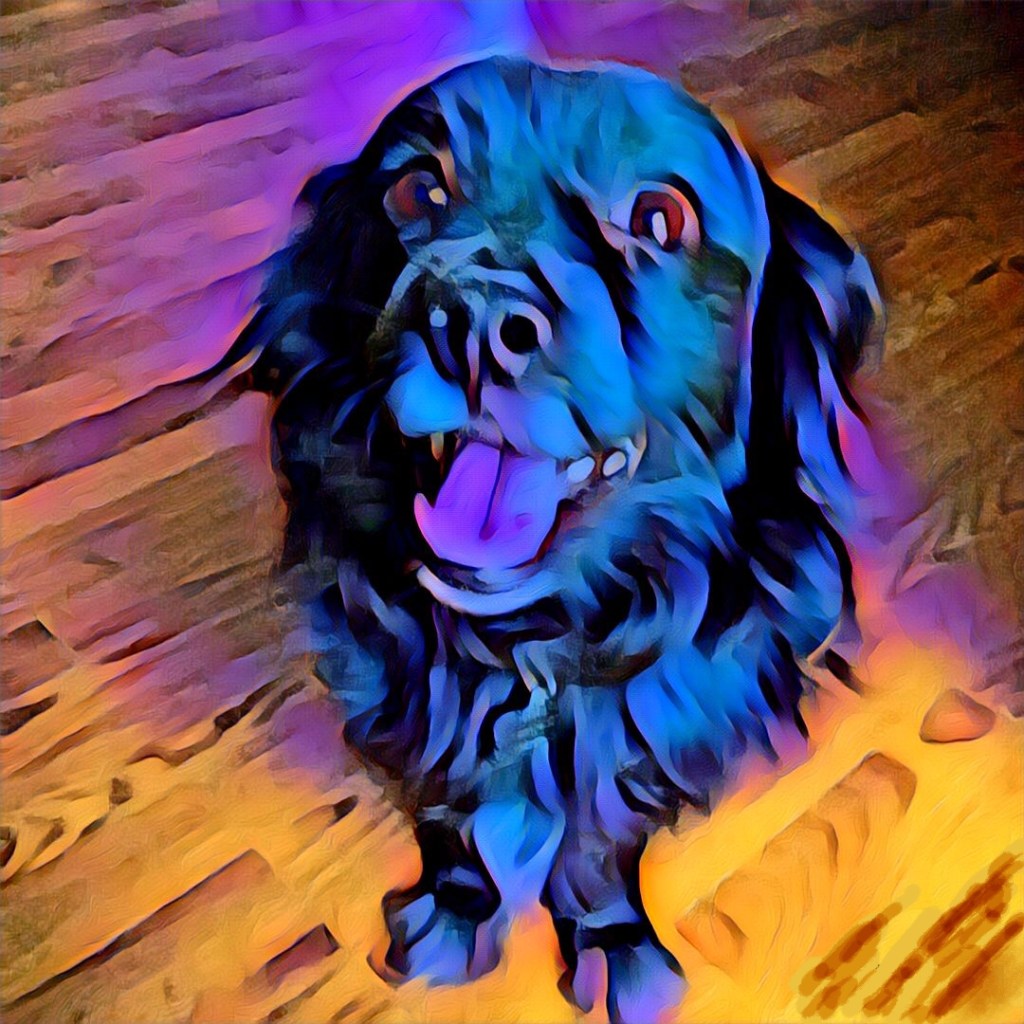
Hugh, Heart Leaping (Image credit: S.T. Ranscht)
Sitting waiting not
for his master’s voice but when
keys jangle heart leaps
That’s my response to the latest Writers Co-op prompt, “Jangling”. Please visit the site to read the others. It’s inspiring to see how different each take is from the others.
I invite you to submit your own responses to any or all of our Show Case’s future prompts. The easy submission guidelines are: any genre, approximately 6 – 1,000 words. The next prompt is
Kicking off
Email yours as a .docx, .doc, or .pdf to stranscht@scbglobal.net by Monday, February 21, 2022.
And please, share Show Case with your family and friends.
My next book is finally announced! A Few Beautiful Minutes, a lyrical picture book exploring the science and wonder of solar eclipses, will be published by Little, Brown in Fall 2023.
I’ve been enamored with solar eclipses since I saw the 2017 eclipse, and I’m thrilled this book will be out ahead of the next North American total solar eclipse. Getting a book published by Little, Brown is a dream come true, and Khoa Le’s illustrations are brilliant and moving. I can’t wait to see what she creates!
I’m incredibly grateful to my agent, Leslie Zampetti, who has believed in this book from the start and has helped make it what it is, and to Hallie Tibbetts and Deirdre Jones at Little, Brown Young Readers for bringing to life. And many thanks to my critique partners whose fingerprints are all over this book and the rest of my work.
The current Writers Co-op Show Case prompt is Interior. This story is my contribution. Please visit Writers Co-op and read them all. Maybe submit your own piece for the next Show Case. The easy-going guidelines are: any genre, approximately 6-1,000 words, emailed to stranscht@sbcglobal.net by Monday, February 7, 2022. The next prompt is:
Jangling
And please share these worthy works with your family and friends!
The House
by S.T. Ranscht
I don’t know why I come here.
Every time Shannon found herself on the front walk that was more cracks than pavement, staring up at the three-story Victorian, she had no idea how she’d gotten there, either. If she’d driven, she couldn’t see where her car or the road she must have taken might be. It was as though the house had materialized in front of her. Or maybe she had materialized in front of the house.
There were no other buildings among the gangly trees huddled in thirsty tangles leaning toward the decayed fence that was almost half as tall as the house. Long ago, the fence must have surrounded a vibrant landscape of flower gardens and vegetable patches separated by expansive lawns crossed by gravel paths. There must have been twittering birds flitting from branch to branch. Now, nettles and scraggly bushes snarled together to choke the path and scrabble up the walls. Silence hung from the trees.
Even with its faded yellow paint peeling like a three-day-old sunburn, the house looked friendly — almost welcoming. Although she didn’t remember ever opening the front door, Shannon knew this house. Things might be rearranged or in slightly different condition from the last time she was inside, but she knew its secrets. She felt their weight.
Closing her eyes, she thought, I should leave.
As had happened so many times before, when she opened her eyes, she was in the living room. Age-darkened wallpaper might have boasted cabbage roses and scissor-tailed swallows. Or maybe brain corals and sea monsters lurked just below the grime. Plaster above picture rails mapped the ceiling with hairline fractures and the floor with crumbles and dust.
Her feet carried her across the scuffed, worn boards to the fireplace, where a thick blanket of cold ash, dead evidence of a living past, lay beneath the grate. Pressing her shoulder against the wall beside the mantle, a narrow gap opened. She squeezed into the space behind the fireplace, and the gap vanished. Relief swaddled her. She was safe here, but she couldn’t stay. She faced the decrepit lengths of wood nailed into the hidden wall, a cockeyed mockery of ladder rungs.
A whisper of dread woke something in her brain, but she wasn’t sure if it was a memory or her imagination. She climbed.
Halfway up the wall, she paused at a window overlooking the backyard. Beyond the broken-down fence, a chain of shadows advanced among the trees. They were coming. They came every time she was here, and she never welcomed them.
Would they get in this time?
Did I bolt the front door?
She wanted to go back and check, but somehow she was in the garret at the top of the house, watching the invaders push through the fence into the yard. They didn’t always get that far. Her heartbeat pulsed behind her eyes. Could she get to the door before they did?
Her rush to the stairs skidded to a stop. The top step hung above the wreckage of the others on the floor fifteen feet below. Panic-tinged confusion swirled around her as she spun searching for a way down.
The lift! She ran back to the garret. There, in the corner. More a dumbwaiter than an elevator, it allowed her to fold herself into it and lower the box to the ground.
Extricating herself, she raced to the front of the house. Unknown people, lips pressed straight, eyes hooded, crowded past the window next to the door. Before she could reach the knob, it turned. The door creaked inward.
NO!
Shannon threw herself against the door and twisted the deadbolt latch. Outside, commotion surged forward calling her name, banging on the door, the walls, the windows. She fled to the fireplace and pushed next to the mantle, escaping into the gap.
She would stay there until silence returned.
~~~
Shannon’s mother wept from exhaustion and fear that her daughter was no longer within reach. Every day for a year, she had come to sit beside her bed, reading out loud, telling her about her family and friends, what they were doing, how much they missed her. Today, for the first time, the doctor suggested they start considering “alternatives” to life support.
She knew in her heart there was only one alternative.
. . . in the Deep Woods (Image credit: S.T. Ranscht)
Here’s my response to the Writers Co-op Show Case prompt Galaxy. Please visit Writers Co-op and read them all. Maybe submit your own piece for the next Show Case. The guidelines are: any genre, approximately 6-1,000 words, emailed to stranscht@sbcglobal.net by Monday, February 7, 2022. The next prompt is:
Jangling
And please share these worthy works with your family and friends!
A Fairy Tale
by S.T. Ranscht
Rumors slunk down the gentle hillsides of the Deep Woods to spread through the encircling villages. A ravenous monster — beast — creature of some sort had awoken to begin devouring all life within its widening range.
The truth was, no one knew how long the unnamed fear may have been awake or lain dormant before the rumors, or even if it had always been there or had arrived from some foreign land beyond their knowledge. Throughout their history, few from any of the villages were willing to enter the Woods. They were too dark, too suffocating, too terrifying. Children played on the safe side of the tall fences and walls their villages had built between the residents and the dense expanse of trees from whence their water sources flowed. Hunters and woodcutters kept their homes in sight whenever they plied their trades beneath the shadowy boughs at the Woods’ fringy edges. And the rare fools who thought to pass through the Woods’ center to get to the other side were never seen again.
~~~
Olaf was not a fool. Everyone he met agreed he was odd but brilliant and quite as far from foolish as it was possible to be. Olaf was an inventor. Villagers from far and wide sought his help from the time he was a young man, not yet old enough to establish his own home away from his parents’. People hired him to solve problems from building better rodent traps to improving their fields’ irrigation systems.
That was how he met Elea. She accompanied her father when he came to Olaf seeking a way to retrieve stricken prey and errant arrows without having to follow them into the Deep Woods. Their meeting turned to courtship, and by the time he fulfilled her father’s commission, they were pledged to one another. During their long — but childless — marriage, his devoted wife was fond of saying, “Olaf is no stranger than you or I, but his brain is unlike any this land has ever seen.”
While Elea was still alive, he created machines that eased her work to keep their household clean and warm. With one, he replaced the wash board she used at the river with a large water tub on legs that stood in the kitchen. Olaf installed a set of paddles in the tub that agitated the laundry when cranked by hand. A pair of hand-cranked rollers attached to the outside of the tub wrung the wash water from the clothing. Another of his inventions ran a grid of clay pipes beneath the plank floor of their little house to connect the kitchen stove to a stove in the bedroom and the fireplace in the main room. Heat that traveled through the pipes warmed the floors, and thence their feet.
When Elea fell ill from a disease that seemed to afflict people in every village surrounding the Deep Woods, doctors determined the illness had come from water tainted at the source. They had no treatment to offer. Village leaders came to Olaf begging for a filtration system that could eliminate the problem. Olaf worked day and night to devise one. It altered the water rather than filtered it, but his success came too late to save his beloved wife.
With Elea’s death, Olaf took his grief into his workshop and locked his attention on the problem in the Deep Woods. Knowing better than to hike into the Woods, he built an airship powered by wind, steam, and hot air to gain an aerial view and at least a chance of evading capture by whatever deadly presence lurked within. Aboard Elea’s Revenge, once he knew the enemy, he was confident he would be victorious.
He wondered if the tainted water could be used against the creature, and tried mixing it with some of the peculiar powders he had collected over the years. Most of those attempts accomplished nothing, but when he mixed the dark gray and yellow powders with a little of the water and struck a flint over it, the mixture sparked and burst into a swirling stream of flame and smoke and ash accelerating toward the ceiling. Curious. He set about making as many barrels of the mixture as the airship would hold.
~~~
Gnawing, echoing hunger growled through the nagging hollow in the creature’s gut. It couldn’t hear. It couldn’t see. It had no memories and no dreams. It hungered. It wasn’t starving. It simply expanded and absorbed what it encountered. But no matter how constantly the creature fed, it was never enough. It was as though the life it consumed provided insufficient nourishment. Or worse, an entirely wrong kind of nourishment. But it didn’t question. It just fed.
~~~
Olaf steered Elea’s Revenge toward the crown of the Deep Woods, ascending the hillside amidst the humming, ratchety-purr of the ship’s engine. Evening breezes pulled her dozen swollen sails beyond the reach of the Woods’ gnarled branches while the descending sun pushed the airship’s shadow across the glinting canopy.
The shadow crested the hill and vanished into a circle of darkness so deep it might have been a tunnel to the center of the world. Matte black, it had no visible features except its shape and size. Olaf watched in horror as it crept outward, inexorably extracting the ring of ancient trees that leaned into the void.
The airship’s bow dipped steeply toward the ground, shaking Olaf from his disbelief. The inevitable destruction of his world was suddenly clear. Turning the ship hard toward the creature’s edge, he pulled Elea’s Revenge up, gaining speed as it seemed flung from the scene below.
He lashed the tiller to circle the creature far enough away to resist its pull, but near enough to hope to kill it, and lit the first barrel’s fuse. Seconds before it would ignite the mixture, he hefted it overboard. It fell and fell and fell. In the instant before it faded into the gaping maw, it spit a shower of sparks. The creature made no response.
Olaf stood in stunned silence. Choosing the only option with any hope of success, he ran from barrel to barrel throughout the hold and on the deck, lighting all the fuses. Taking control of the tiller, he turned Elea’s Revenge toward the creature and aimed the prow at its heart.
“I owe you this, my love.”
~~~
The ground beneath the encircling villages shook. Houses shivered. People ran outside to see what might have happened. All who looked toward the Dark Woods saw the column of flame and smoke and ash racing into the twilit sky. As it separated from the Woods, the darkness at its tail blotted out the emerging stars, and still it accelerated upward.
What they would not live to see happened over eons far, far from their world: A swirl of stars gathered in the creature’s wake, colliding and giving birth and sorting themselves into a vast community around the creature itself. Whether to be eaten or thrive might never be known.
A recent Writers Co-op Show Case presented six successful views of Failure. My revised version is below, but I hope you’ll visit Writers Co-op and read them all. Maybe submit your own piece for the next Show Case. The guidelines are: any genre, approximately 6-1,000 words, emailed to stranscht@sbcglobal.net by Monday, January 24, 2022. The next prompt is:
Interior
And please share these worthy works with your family and friends!
Who is Failure?
by S.T. Ranscht
Pointing at one bubble shape on the monitor and then the other, “Two placentas,” the doctor announced. “Fraternal twins. Do you want to know their sex?”
The woman and the man looked to each other. He took her hand, his nod scarcely noticeable. Smiling, she said, “Yes, we do.”
“One son, one daughter.”
The man closed his eyes and inhaled deeply. He lifted his face heavenward and breathed out, “Thank God, a son.”
“And a daughter,” the woman added.
“As a precaution,” the doctor admonished her, “to lessen the chances of another miscarriage — considering your age and barring chromosomal problems — this time you really must take the pre-natal vitamins. Cut out caffeine and alcohol. No smoking or drugs.” He made a note to the file. “I wish you lived closer to a hospital.”
The man looked puzzled. “But those other five were all girls. This time is different.”
“Is it?” the woman asked.
The doctor shrugged. “Let’s start by seeing if you can make it through the first 20 weeks. Then there’s reason to hope.”
~~~
Together the woman and the man started working on the nursery at the end of week 20.
Now, almost four months later, they stood in its doorway admiring the room they had painted and furnished to embody the woods where Hansel and Gretel had conquered a wicked witch. The man had built a gingerbread doll house for his daughter and a bas relief climbing tree against one wall for his son. The woman had painted a mural of trees with birds and woodland creatures all the way around the room.
On the son’s side, the man added a child-sized tool kit and sporting equipment from every team sport he had played growing up. On the daughter’s side, the woman displayed dolls and stuffed animals and framed photographs of women Olympic athletes. In the center, they placed a rustic bookshelf the man had built filled with books they had chosen together.
“This is a room children will grow up strong in,” he said. “They’ll know they can do anything. Be anything.”
The woman gasped. “It’s time to go,” she said.
~~~
“Meet your daughter,” the nurse said as she placed the first baby on the woman’s chest. The man leaned over them to see his daughter’s face.
“She’s perfect,” the woman said.
“She’s so tiny,” the man said. He looked up to watch for his son.
The doctor whispered something to the nurse, who came to take the man by his arm. “Will you come with me for just a moment please?” she asked. She left him in the hall and closed the door behind her.
Silence hung in the air until the woman’s wail pierced the door.
~~~
The man had taken the tools and sporting equipment out of the room as soon as they brought the baby home. When he started taking the climbing tree down, the woman said, “Please leave it. Girls can climb trees. I used to climb trees.”
The man never went into the room after that.
Now, cradling the girl in his arms the man said, “She never looks me in the eye. Don’t two-year-olds look people in the eye? Is she blind?” He handed her to the woman.
The woman passed a purple stuffed dinosaur over the girl’s face. The girl followed it with her eyes. “She’s not blind.”
“Shouldn’t she be saying at least a few words by now?” the man asked. “Shouldn’t she know how to walk?”
The woman’s voice wavered, “Children learn at different rates.”
The man’s eyes filled. “What’s wrong with her?” He left the house. He did not pick the girl up after that.
The woman held her daughter inches in front of her. The girl’s eyes drifted across and up and down, but never focused on her mother’s face.
The woman’s eyes filled. She put the girl to bed with the purple dinosaur.
~~~
“She’s four years old. Why doesn’t she talk yet? Is she deaf?” Fast and hard, the girl’s father smacked his hands together.
She startled.
The girl’s mother jammed the blade into another potato, guillotining it against the cutting board. “She’s not deaf.”
“Then what’s wrong with her?” he asked yet again, peering into eyes that saw but didn’t comprehend. He turned his back and left the kitchen.
Wrong with her. The girl smacked her hands together. Again. And again. Again and again. And again and again.
The knife clattered on the counter and the girl’s mother stooped to hold her daughter’s hands apart. “Stop,” she said, begging, “Don’t you understand me?”
The girl’s arms yanked away. Her legs lurched her unsteadily out of the kitchen, her hands flapping beside her shoulders like wounded birds. Stop. Stop. Stop.
~~~
“Of course the school can’t handle her,” the girl’s father grunted from behind his cereal box. “She doesn’t talk and she can’t understand any better than a wild animal. Look at her.”
Look, look, look. Undeniably no longer a girl, the young woman stood in the doorway, one foot stamping, stamping, stamping, driven by the hammering thrust of her head-banging bounce. Body wild. Inside see me. See. See. Face swiveling toward him, eyes locking on his for one sticky instant as, arms outstretched, her hands smacked together.
He looked away.
The young woman’s mother smoothed the school’s letter on the table. “It says there’s a school over in Columbus could take her. Says it’s expensive, but they could help her.”
“You know I can’t pay for some expensive school.”
“Or they can send someone to show us how to help her.”
“How much is that?” he asked.
“ ‘No cost to you.’ ”
“Do that one. They can show you how to help.”
The young woman smacked her hands together. Help. Help. Help.
~~~
The young woman’s arms flung semaphoric gibberish above teetering steps defying direction.
Her mother hung back while the home care worker followed close. “When Angeline can’t stop herself,” the worker instructed, “she needs someone to help her.” From behind the young woman, the home care worker embraced her to clasp her arms against her sides and pressed one hand on the top of her head, compelling her feet to stand.
Eyes wide, the young woman alerted. Solid. Body silent listening. I am real. Do they see me?
Her mother fretted, “What if she feels like you’re over-powering her? Can she even understand what you’re doing for her? Won’t that make her want to keep away from you?”
The worker smiled. “She has developed an awareness of people outside herself. Although it might not be possible for us to understand how Angeline judges our interactions with her, she can recognize how her body is reacting even though she can’t always control it.”
“But she can’t tell us what she’s thinking.”
“It’s true she hasn’t developed language the way you and I understand it,” the worker said. “No one is born with language. We usually learn to communicate by watching and listening to people speak — their facial expressions, body language, words and inflections. Your daughter doesn’t read our faces or bodies or vocal tone, but as an infant, she developed her own language.”
“Her own language? Then why doesn’t she speak?”
“The language of her thoughts would be based on emotions, wants and needs, and primarily visual stimuli rather than words she hears you saying. Her syntax wouldn’t be the same as our spoken language.”
“What does that mean?”
“Her thoughts might be more metaphorical than literal. She might identify objects or feelings as combinations of things she knows that give them fuller symbolic meaning than their names would.”
Angeline’s mother tried to meet her daughter’s eyes. “Will we ever be able to understand her?”
“Many non-speaking autistic people learn to read. If you can teach Angeline to read, you may unlock her ability to express her thoughts. It might not be with speech, but she might use a spelling board or sign language you develop together.”
“I don’t know how to do that.”
“Let’s help her learn to be still, first.” The care worker released the young woman.
Angeline remained standing as she was for three heartbeats before staggering on.
~~~
Days and weeks repeated until the home care worker’s help moved on.
“So she’s gone. She gave up,” the father accused.
The mother wrung her hands. “She said we don’t need her anymore.”
“Right,” he said, “a total waste of time. The girl still doesn’t talk. She still can’t understand anything that’s going on. She’ll never be anything.” He shook his head watching her lie on the ground.
Still. Sunshine feels my face and fills me. Heart music carries me. Sky presses my arms and legs lying on leafy bed. My body smiles.
They fail seeing I am not failure. I am real.
Her mother sat down beside her with a picture book and took her hand. “Look, Angeline, I want to show you something.”
Angeline’s father stopped shaking his head and watched.
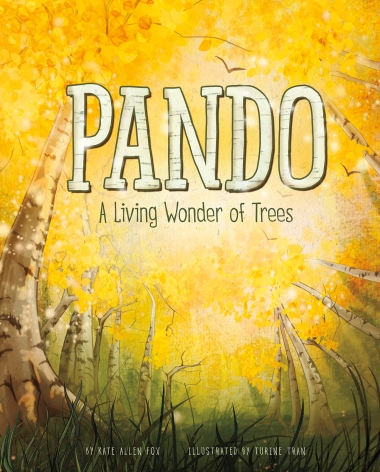
Kate Allen Fox, has written a beautiful treasure of a children’s book, Pando: A Living Wonder of Trees. I own it and I highly recommend it, especially to anyone who reads to children or spends time with children who read. (It’s available from Leopard Print Books, Barnes and Noble, your local bookseller, and Amazon.
On February 2, 2022, children’s authors will be offering FREE virtual readings to students everywhere through World Read Aloud Day (WRAD).
Kate is thrilled to participate this year and is offering six 20-minute slots to read her science-based, nonfiction picture book, Pando: A Living Wonder of Trees, which has been named one of the best books of the year by School Library Journal and Chicago Public Library.
Your WRAD virtual visit will go something like this:
1-2 minutes: Kate will give a quick introduction & talk a little about her book. 3-5 minutes: Kate will read aloud Pando: A Living Wonder of Trees. 5-10 minutes: Kate will answer a few questions from students about writing, science, environmentalism, or anything else on their minds. 1-2 minutes: Kate will recommend a couple books she loves (but didn’t write!) for the kids.
Please share this information with any educators who might be interested, and happy reading!
The latest Writers Co-op Writing Prompt Challenge Show Case is up for your enjoyment. The prompt was Entitled, and I’ll share my contribution here, too. I hope you’ll peruse the rest of them, and consider submitting a piece of your own for the next prompt:
Failure
Those submissions are due by the end of Monday, December 13, 2021. (See the Show Case for oh-so-easy submission guidelines.)
I’m Just Really Good at My Job
by S.T. Ranscht
“Hello, Adam. Welcome to my world. Your world.”
“Uhhh… thank you?”
“I know, it’s all a bit too glorious, isn’t it?” the world’s owner confided gleefully.
Adam hesitated. “Well, I suppose that depends on what you mean by ‘glorious’.”
The owner seemed taken aback. “I should have thought it was obvious.”
“Not to me,” Adam admitted. “I mean, compared to what?”
“Oh. Right.” A pause followed.
“Can I ask you a question?” Adam ventured into the pause.
“Yes, I have granted you that ability.”
“Okaaayyy… How did I get here?”
The owner’s glee returned. “That’s a great story. I suggested that we make man in our own image, and everyone agreed—“
“Who’s ‘we’?”
“That’s not important. I’m this world’s Project Manager, so you’ll deal only with me.” The PM hurried on, “Anyway, I made this dense fog cover the entire globe so everything everywhere got really wet, and then… I made you out of mud. Mud! Then, you know the thing with two holes in the middle of your face?”
“My… nose?”
“I wasn’t sure you knew that word. Yes, your nose. Get this — I blew into it and guess what happened. You came. To. Life.”
“Huh.” Adam tried to rub the confusion out of his brain by massaging his forehead. Hard. “That’s not really much of a story. I don’t mean that in a negative way. This is just constructive criticism you can take or leave. It has good plot points, but your execution is weak. Not enough world building. No character development. No tension. The climax is contrived — all those periods, supposedly to give each word equal impact. And no resolution.” He shook his head. “I’m just saying it could be a really compelling story if you added more detail. Some dialogue. Motivation. Why, for instance, did you decide to blow into my nose?”
“Thank you for your feedback,” the PM said in a way Adam thought sounded a little pouty. “I’ll consider it if I ever decide to tell that story again.”
“So, what am I supposed to do?”
“Well, I had a couple of ideas. You get to name every living creature and growing thing.”
“What? Like Javier, Su Mei, and Thaddeus? Or Spot, Splashy, and Flighty?”
“Not what I had in mind, but the deal is made and it’s up to you.”
“Maybe something more evocative of each living thing’s life story,” Adam contemplated. “Yes, that would be much more interesting.”
“As you wish,” the PM acceded. “And you get to till the land in this garden. You know, grow more plants. For food.”
“That sounds like tedious, backbreaking, thankless work. No thank you. What are my other choices?”
“Other choices? I was hoping this wouldn’t come up quite so soon — especially because I’m having second thoughts about its wisdom — but, yes, having made you in our image, I thought it would only be fair to grant you free will, too. You may do anything you want — except for two tiny exceptions. So. I can hardly wait to find out: What do you want to do?”
“I’m not sure you really mean that, but,” Adam announced, “I want to be a writer.”
“Oh. I’m afraid that’s not an option.”
“But you said, ‘anything’.”
“That I did, but I haven’t invented writing yet,” the PMsplained with forced patience.
“Then maybe I just invented it,” Adam countered. “After all, I am free to define myself, correct?”
“Yeeesss.”
Adam decided right then that, even though he couldn’t see the PM, the tone he’d just used was accompanied by eye rolling. Adam filed that image away for future stories.
“I’m curious,” Adam began, “Why can’t I see you?”
The PM chuckled in a pitying way. “Looking upon my face would be too overwhelming for you, a mere man.”
“Really? I would have thought, having made me in y’all’s image, y’all would have a face like mine. What’s the real reason you’re hiding? Are you hideous and misshapen? Scarred beyond belief? Or just everyday ugly?” In the silence that followed, Adam imagined the PM glaring at him, crossing his arms, and tapping his foot in an aggravated way. The power he felt inspired his first naming. “Hey, do you see that sinuous, slithery creature over by the apple tree? I’m going to name him ‘The Great Deceiver’.”
The PM scoffed, “That’s not a proper name. That’s a title.”
“Precisely,” Adam agreed. “I’m a writer. A storyteller. And I just entitled your glorious creature’s life story.” Adam’s grin radiated a heavenly glow. “But I thank you for your feedback.”
The PM drew a deep breath. “Adam, I am going to give you a gift. You may name her whatever you deem appropriate, but I will call her Eve.”
“I don’t need a companion,” Adam replied. “In fact, I don’t want a companion. Writing is going to be a solitary job. A companion would just be a distraction.”
“Perhaps so,” the PM allowed, “but a writer is entitled to an editor.”
A frown crept over Adam’s face. “That sounds really annoying.”
If the PM’s face had been visible to him, Adam would have seen his first nastily satisfied smile.





 Space, Time, and Raspberries
You must be logged in to post a comment.