Having survived valve repair surgery and an experimental cardiac bypass at age 5, three years before it was an accepted medical procedure, Susan grew into the size of her overworked and enlarged heart. Maybe she thought she had enough to give it away -- twice. Both times, she had to retrieve the shattered pieces and puzzle them back together. She thanks her Dad for the only advice of his she ever followed to the letter: "Never get married. Learn to take care of yourself." So of course she is a writer. Susan has co-written a YA SciFi novel, and has three more novels in various stages of evolution. She's had several short stories published in other people's anthologies, some of which were contest-related.
Let her tell you a story...
The natural gas that fuels our furnaces, water heaters, and gas stoves is naturally odorless. But it’s also highly flammable and dangerous, so sulfur is added to it to give it a distinctive odor, in case of leaks. My dad taught me early in my life to pay attention and tell an adult if I smelled gas.
When I grew up, I learned the gas company wanted us to report the smell of leaking gas to them immediately, so they could avert a potentially deadly catastrophe. They were confident. I never questioned their authority, especially because they said the same thing my dad did, and he was a trusted source.
I think it’s normal to respect people we trust or people we don’t know who speak with confidence. We’re inclined to believe they know what they’re talking about, and the speaker I was listening to recently was almost stridently confident. But when I heard the insistent Karoline Leavitt say:
I have been absent from here for a long time — a story for the future. I don’t know how many people will see this, much less read it. In a not-so-secret pocket of my heart, I hope at least one thoughtful reader will share it with at least one other thoughtful reader and so on and on and on . . .
Don’t we all? Dream on . . .
— You, a fellow blogger
I never took a class specifically about Civics. No, not Honda Civics. The study of the rights and duties — the privileges and obligations — of citizens. I’m not sure I could even define “civics” before I graduated from high school.
Since then, I’ve had many civic experiences. Like, voting — both a right and a duty. Every election is a chance for us (the citizens) to wield our personal, non-violent power to form a majority opinion about how we will be governed. That’s because our government’s authority and legitimacy require the “consent of the governed” That’s us. If we don’t consent, the government can’t last. This also depends on each of us committing to live under the Rule of Law.
The Law of the Land in our land, the USofA, is our Founders’ painstakingly-crafted Constitution, complete with the expandable Bill of Rights. The Constitution’s Prelude defines our Government’s reason for being with a list of our expectations. The Constitution’s body delineates the unique structure of our Government with its three independent branches. It also sets the Government’s boundaries within a system of checks and balances so that none of the three branches can take control of the other two. You know, so we don’t end up with an anarchy or an oligarchy or a monarch or a dictator or a tyrant.
When we think about the worst problems this world faces, what comes to mind? Climate change? War? Poverty? Racism? Greed?
When I look at that list, I can’t pick one that deserves more attention than any of the others, but only one word comes to mind that could solve all of them.
Education.
Imagine a world where everyone can read and write. Where everyone learns how to think critically. Not only would people have a better chance to work in jobs that could support them financially, but they’d have a better chance of telling fact from fiction — truth from lies or wishful thinking.
While that doesn’t mean everyone would agree on every issue, it would help us understand that our differences enrich our societies and our world. It would make it easier to accept and respect each other knowing that everyone of us has the right to a productive, satisfying life.
“I’m in! Sign me up. What can I do to help us get there?”
You, already knowing how to read and write.
There are probably a thousand things you could do at home, locally, nationally, or globally that would help, and maybe you’re already doing some of them. Reading to young children. Tutoring students who need a boost. Writing articles about social justice. Being an activist for changes that improve people’s lives.
Here’s a small thing you can do: Please support my dear friend Curtis Bausse in his challenge to memorize a Shakespearean sonnet a day, and recite each one while standing on one foot. No kidding. Rest assured, no one is asking you to do the same, but Curtis committed to doing this for 154 days in a row because that’s how many sonnets William wrote. Day 154 is August 15th. As proof, Curtis made videos: https://www.youtube.com/@curtisbausse/videos. You may decide for yourself whether these are evidence of madness. I, however, am proud to contribute to his cause.
The Cause:
In much of the world, education is only an unaffordable dream. The Little Sapphires School in the sapphire mining village of Ambondromifehy, Madagascar, needs funds to build a classroom. In a brief text that is well worth reading, Curtis describes this in a bit more detail. It also includes his evidence that this project is on the up and up.
Or, if you’re willing to take my word for it, you can go directly to his GoFundMe: https://gofund.me/5e64ba0b
But either way, Curtis, the Little Sapphires School, and I thank you sincerely!
Sometimes I get distracted and I don’t even think about having a blog. (Am I the only person who reacts to that word with revulsion — “blog”? It looks like an Orc name and sounds like someone emptying their guts into an echo-y metal waste basket. It is possibly the ugliest word in the English language.)
Anyway, the question of Muses came up, and although I don’t consider myself beholden to a spirit beyond the vagaries of chance to motivate me to create in any medium, I’ve always had this awareness that the center of my core just enjoys creating things. But because I like to answer when someone asks, I looked around at some of the stuff I’ve collected during my lifetime — and enjoyed enough to display — to see if I could find that answer.
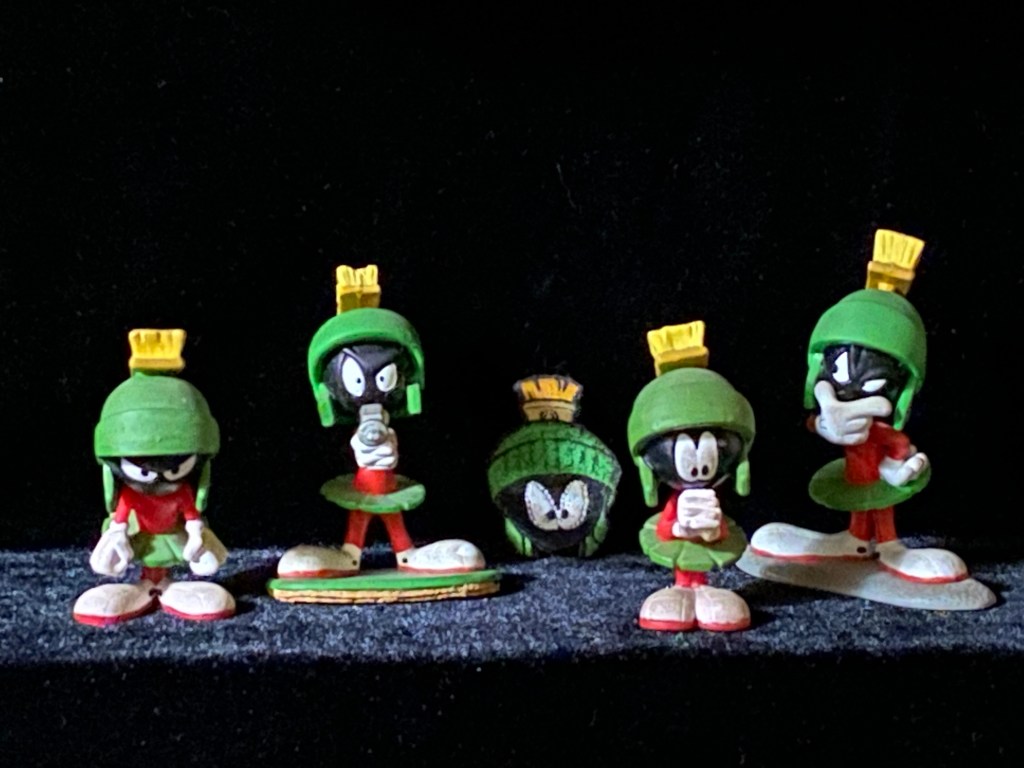
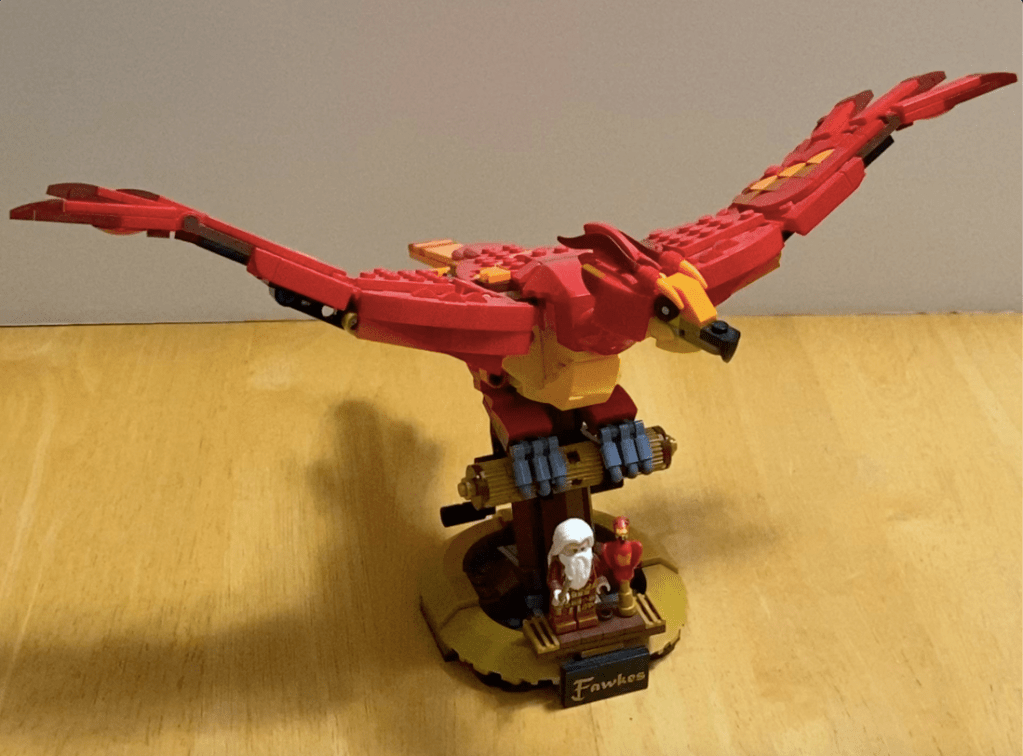
It came down to my Looney Tunes Marvins or my Lego Fawkes the Phoenix (whose wings are geared to rise and lower by crank in an amazingly realistic imitation of bird flight. Honestly, it is sooooo cool! Plus, his head, neck, wingtips, and tail can be posed to add a sense of his emotions.)
Fawkes the Phoenix (Photo credit: S.T. Ranscht
The Choose-A-Mood Marvins won this time, mainly because Fawkes the Phoenix leaves me awed by the engineering involved, and the Marvins tickle my fancy and make me laugh. Maybe when I get serious about reaching for something I fear is unattainable, I’ll turn to Fawkes. But until then — as GD Deckard has pointed out, there is to be
This is a wonderful opportunity to help trauma survivors get their stories and work out to a wider audience.
For those who don’t know,Katie Koestnerwas on the cover of TIME Magazine at the age of 18 as the first person to speak out nationally and publicly as the victim of “date” rape. She is now the Producer and Host of the Dear Katie: Survivor Stories podcast.
My function is two fold. One, to find any creatives (not just authors) whose work deals with trauma and healing, and engage them in podcast conversations regarding their work and their lives post trauma. Two, to help find trauma survivors who’ll share their stories for the mainDear Katiepodcast, review episodes before they go to air, edit, and make suggestions as necessary.
Please leave a comment if you or someone you know has written a fiction or non-fiction…
The Writers Co-op prompt was “Out”. You can read the other worthy submissions here.
Share with your family and friends if you think they’d enjoy reading short original works by a creative bunch of writers. Maybe even write your own piece for the current prompt. We’d love to have you!
Consciously, I had nothing to add when I posted a photo recently. But the pot always simmers. I brooded on the word “victory” in a comment by Sue Ranscht. I recalled the epic journey across northern Norway in World War 2 by Jan Baalsrud, the sole survivor of a commando force betrayed by a Nazi collaborator. I seized another day of magical light and found there was more to show and to say.
Here’s a recent Writers Co-op writing prompt: Nothing. It’s really something. I’m always impressed by the variety of responses writers submit. Mine is below, but please take a few minutes to read the rest. And maybe share this post or that one with your family, friends, and followers.
This is my response to Writers Co-op’s latest writing prompt, “Mashup“. I hope you’ll stop by their Show Case to enjoy all the highly creative and original entries. Maybe they’ll inspire you to submit your own for the next prompt:
Nothing
Guidelines are easy: any genre, approximately 6-1,000 words. Submissions are due by April 4, 2022, attached as a .docx to an email to stranscht@sbcglobal.net.
Daylight Savings Bank
by S.T. Ranscht
The first time I used my Facebook — oops, sorry, META — Daylight Savings Bank card, I bought 15 minutes of daylight to avoid having to wake up in the dark the next morning. It was a special occasion — my birthday — and I was leaving on a jet plane for a long-planned, well-deserved vacation in the tropics. If I had jet lag, I figured I wouldn’t miss the 18.3 minutes (15 minutes at 22%) of additional darkness that would trim sunshine off the end of that day to pay for it. If I didn’t suffer from jet lag, I could pay the higher interest rate of 33% (19.95 minutes) to defer payment up till the end of the test period.
At only 25 years of age, I was one of Daylight Savings Bank’s lucky beta testers. Tens of millions all over the world had applied, but only a hundred thousand were chosen by lottery to experience the freedom of deciding how many hours of daylight their days would hold.
You’re probably wondering how this could possibly work — I think we all were. First, every applicant had to read and agree to the 10-page TOS on DSB’s website before META held the lottery. This was meant “to give applicants the opportunity to inform their consent and withdraw their application if they so choose.” Then it got pretty technical — something about transactions “disrupting/resetting circadian rhythms” and extended use “realigning applicable relative longevity standards”.
To me, the most important part was the sliding interest rate scale. I just wanted the longest, sunniest days I could afford. Of course, as beta testers, we didn’t have to pay any money for the extra light or dark — we chose extra light (or dark) at one end (or both ends) of the day, and had to accept an equal amount of dark (or light) plus interest, either the same day or by the end of the 30-day beta testing period.
Second, the actual process sounded like a METAverse thing on steroids: After DSB’s thorough physical and mental examinations to establish each selected participant’s beginning health baseline, each participant would be “surgically fitted with temporarily permanent lenses” that would enable them to “experience sunlight and darkness on their own schedule.” At the end of the beta test, DSB conducted both examinations again, and traded their lenses out for the participant’s own lenses, which I guess must have been cryogenically frozen, just as rumor had it META’s founder, Mark Z. had been fifty years ago.
When I won a slot as a beta tester, I was ready. I paid for my own vacation, but the sunshine would be courtesy of Daylight Savings Bank.
After my first timid appropriation of extra sunshine and a daylong flight, there I was, on one of those little South Pacific islands that’s dominated by a super-luxurious resort that looks like it could sink the place. I was so energized, I added five more hours of sun that first night and deferred all payments from then on. From the golf course, you could whack a ball right into the ocean. Imagine snorkeling near a coral reef among exotic tropical fish, giant sea turtles, and sharks. (Just watch out for those golf balls.) Sailing, surfing, wind surfing, parasailing. Hiking, fishing, swimming, canoeing. Waterfalls, bamboo groves, volcanoes. Meal after extraordinary meal. Sea grapes. I did it all, I saw it all, and I needed only five extra hours of daylight every day for 23 days. No wonder I was moving more slowly toward the end.
But my exit examinations established a different explanation. While my body and my mind had successfully reset my circadian rhythms to my eighteen hours of sun/six hours of darkness schedule, my applicable relative longevity standard was now that of a 70-year old woman.
Even worse, my deferred payments were due. I had to live the next seven days in total darkness before DSB would trade out my lenses. Seems to me setting the clock ahead to permanent Daylight Saving Time would have been a much healthier option.







 Space, Time, and Raspberries
You must be logged in to post a comment.